WHY AMERICA MUST BUILD BEYOND THE CITY AND BACK INTO THE TOWNS THAT FEED, POWER, AND GROUND THIS COUNTRY!
By Ericson Tua'one Chief Executive | Ber Wilson
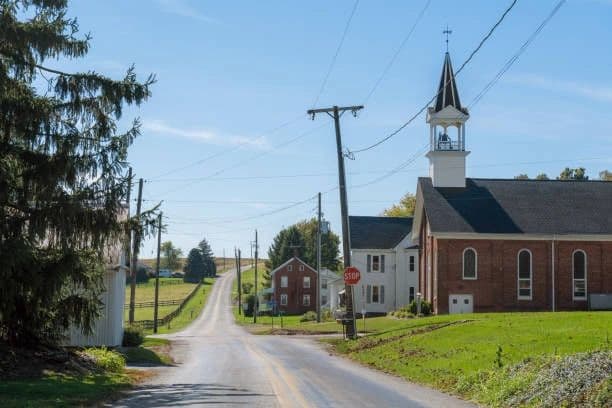
At first light, the town looks like it is holding its breath.
A pickup rolls past a row of dark storefronts. A flag moves a little in the wind. The water tower catches the morning sun and throws it back across a quiet street that used to carry more business, more noise, and more reason for young families to stay. In towns like this across Utah, the bones of a real community are still there. So is the feeling that one more decade of neglect could push it too far.
Then the drive turns north.
The traffic thickens. Rooftops push farther out. Construction cranes mark the horizon. Every mile closer to the Wasatch Front feels tighter than the one before it. Utah is projected to be short 235,000 homes over the next 30 years, and average home prices have already climbed past $517,000. The state keeps trying to solve that pressure by forcing more people, more buildings, and more strain into the same corridor.
That is the story Utah keeps telling itself: growth has to go where growth already is.
That story is wearing out.
Utah does not just have a housing problem. It has a placement problem. The state keeps loading more demand into the Wasatch Front while too many smaller cities and rural towns wait for the roads, utilities, broadband, and commercial investment that would let them grow with purpose. Research on smart growth in small towns shows that investing in existing rural centers can protect open land, reduce travel burdens, and help create communities that can support themselves over time. If Utah wants to relieve pressure on the Wasatch Front, it has to stop treating the rest of the map like an afterthought.
That point is not theoretical. When a town gets ignored, the pattern is always familiar. Employers thin out. Storefronts go quiet. Families start doing the math and leave. None of that happens because the town lacks worth. It happens because nobody put in the infrastructure that gives a town a fighting chance.
And when a town does get that chance, the story changes.
You can see it in communities that kept their identity and invested in the basics. Small-town revitalization research points to the same ingredients again and again: strong local leadership, workforce investment, community identity, and infrastructure that supports jobs instead of chasing them away. Utah already has towns with those bones. What too many of them still lack is the buildout.
Water first
Utah has solved hard problems before.
When the pioneers arrived in the Salt Lake Valley in 1847, they arrived in a dry place with no room for waste. Within days, they diverted City Creek and started building irrigation. Over time, they created one of the first large-scale irrigation systems in the American West. The principle behind that work was simple: use what is needed, share responsibility, and build systems that serve the whole community.
That principle still fits Utah.
Today, about 75 to 80 percent of Utah's water withdrawals go to irrigation. Farmers across the state are already adapting with drip irrigation, laser leveling, soil-moisture monitoring, and other conservation practices designed to make every gallon work harder. That same discipline should shape how the next generation of Utah communities gets built. Water conservation cannot be a brochure promise added after the renderings are done. It has to be in the plan from day one: in the landscaping, in the irrigation, in the piping, in the storage, and in the expectations for how a town grows.
The pioneers did not build first and ask about water later. They understood that water was the plan.
Utah should remember that.
Bury the lines
The West has another lesson, and it is written in ash.
A line sags. Wind rises. Dry brush catches. Then a town pays for a decision someone once called too expensive to fix.
In California, overhead electrical lines were responsible for 65 percent of the total acres burned in 2019. Major wildfire investigations have shown again and again how exposed overhead systems become in dry, high-wind conditions. Utah has already recognized that wildfire risk is rising. In 2025, the state approved new wildfire funding and required wildfire-related building code considerations in every county.
That is a serious step. It should be the floor, not the ceiling.
If Utah is building new infrastructure in growing rural towns and fire-prone areas, then the practical answer should be obvious: bury the power lines. Underground utilities can reduce ignition risk from overhead lines by about 98 percent, while also reducing weather-related outages and cutting back on the vegetation management burden that comes with overhead systems. Undergrounding is not cheap, but neither is rebuilding after a fire.
The smartest moment to make that investment is while the ground is already open.
Build like risk is real
Too many projects still treat resilience like an add-on. It is not. It is the assignment.
The UN Sendai Framework for Disaster Risk Reduction gives a clear standard: understand risk, strengthen governance, invest in resilience, and Build Back Better. It also pushes planners and builders to stop treating water, wildfire, utilities, and land use like separate issues, because in the real world they collide in the same place, at the same time, and hit the same people.
That framework may be global, but the lesson is local. A Utah town with aging overhead power, thin water capacity, unmanaged growth, and fire exposure does not have four different problems. It has one problem with four symptoms. A builder who understands that will design differently. A developer who understands that will invest differently. A community that understands that has a much better chance of lasting.
Use the right material
This is also why prefab steel belongs in the conversation.
In rural construction, everything has to work harder. Labor is tighter. Timelines are less forgiving. Delays cost more. Prefabricated steel components are built in controlled conditions, which improves precision and quality and reduces on-site construction time. That matters anywhere, but it matters even more in places that do not have time or money to waste.
And in fire-prone country, one point should not need a long debate: steel does not burn.
If a town needs a clinic, a maintenance building, a warehouse, a school addition, or a light industrial facility, prefab steel can give that town speed, strength, and long-term value without pretending that rural budgets work like metro budgets. It is not a shortcut. It is a disciplined way to build serious structures for communities that deserve serious investment.
Cheap is not the same thing as efficient. Fast is not the same thing as careless. Good builders know the difference.
What comes next
Some of the most important work in Utah is not happening in the loudest places. It is waiting in the quieter ones.
It is waiting in towns that still have strong bones, good people, and enough pride left to fight for their future. It is waiting for roads that connect, utilities that hold, broadband that opens opportunity, water systems that respect the land, and buildings designed to stand up to fire, weather, and time. It is waiting for someone to look past the crowded corridor and say, this place matters too.
That is the work worth doing.
Let’s stop forcing all of Utah’s future into one corridor.
Let’s invest in the towns that have been carrying too little of the state’s attention for too long.
Let’s bury the lines, plan for fire, conserve the water, and use the right materials.
Let’s build places where families can afford to stay, businesses can afford to grow, and communities can afford to believe in themselves again.
That is how Utah grows without losing what makes it Utah.
That is how Utah gets built right.
Author:
Ericson Tua'one, Chief Executive, Ber Wilson.